Sunday, January 25, 2009

Electric Charges

Neutral State of an Atom
Elements are often identified by the number of electrons in orbit around the nucleus of the atoms making up the element and by the number of protons in the nucleus. A hydrogen atom, for example, has only one electron and one proton. An aluminum atom (illustrated) has 13 electrons and 13 protons. An atom with an equal number of electrons and protons is said to be electrically neutral.


Positive and Negative Charges
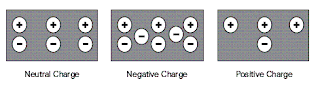
Electrons in the outer band of an atom are easily displaced by the application of some external force. Electrons which are forced out of their orbits can result in a lack of electrons where they leave and an excess of electrons where they come to rest. The lack of electrons is called a positive charge because there are more protons than electrons. The excess of electrons has a negative charge. A positive or negative charge is caused by an absence or excess of electrons. The number of protons remains constant.


Attraction and Repulsion of Electric Charges
The old saying, “opposites attract,” is true when dealing with electric charges. Charged bodies have an invisible electric field around them. When two like-charged bodies are brought together, their electric fields repel one body from the other. When two unlike-charged bodies are brought together, their electric fields attract one body to the other.

The electric field around a charged body forms invisible lines of force. These invisible lines of force cause the attraction or repulsion. Lines of force are shown leaving a body with a positive charge and entering a body with a negative charge.


Coulomb’s Law
During the 18th century a French scientist, Charles A. Coulomb, studied fields of force that surround charged bodies. Coulomb discovered that charged bodies attract or repel each other with a force that is directly proportional to the product of the charges, and inversely proportional to the square of the distance between them. Today we call this Coulomb’s Law of Charges. Simply put, the force of attraction or repulsion depends on the strength of the charges and the distance between them.

Conductors,Insulators and Semiconductors

Conductors An electric current is produced when free electrons move from one atom to the next. Materials that permit many electrons to move freely are called conductors. Copper, silver, aluminum, zinc, brass, and iron are considered good conductors. Copper is the most common material used for conductors and is relatively inexpensive.


Insulators Materials that allow few free electrons are called insulators. Materials such as plastic, rubber, glass, mica, and ceramic are good insulators.


An electric cable is one example of how conductors and insulators are used. Electrons flow along a copper conductor to provide energy to an electric device such as a radio, lamp, or a motor. An insulator around the outside of the copper conductor is provided to keep electrons in the conductor.


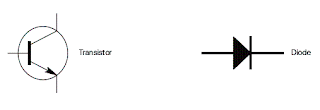
Semiconductors Semiconductor materials, such as silicon, can be used to manufacture devices that have characteristics of both conductors and insulators. Many semiconductor devices will act like a conductor when an external force is applied in one direction. When the external force is applied in the opposite direction, the semiconductor device will act like an insulator. This principle is the basis for transistors, diodes, and other solid-state electronic devices.


Electron Theory

Elements of an Atom All matter is composed of molecules which are made up of a combination of atoms. Atoms have a nucleus with electrons orbiting around it. The nucleus is composed of protons and neutrons (not shown). Most atoms have an equal number of electrons and protons. Electrons have a negative charge (-). Protons have a positive charge (+). Neutrons are neutral. The negative charge of the electrons is balanced by the positive charge of the protons. Electrons are bound in their orbit by the attraction of the protons. These are referred to as bound electrons.


Free Electrons Electrons in the outer band can become free of their orbit by the application of some external force such as movement through a magnetic field, friction, or chemical action. These are referred to as free electrons. A free electron leaves a void which can be filled by an electron forced out of orbit from another atom. As free electrons move from one atom to the next an electron flow is produced. This is the basis of electricity.


Introduction

Welcome to the first course in the STEP series, Siemens Technical Education Program designed to understand basics of electricity more effectively. .

Upon completion of Basics of Electricity you will be able to:

• Explain the difference between conductors and insulators

• Use Ohm’s Law to calculate current, voltage, and resistance

• Calculate equivalent resistance for series, parallel, or series-parallel circuits

• Calculate voltage drop across a resistor

• Calculate power given other basic values

• Identify factors that determine the strength and polarity of a current-carrying coil’s magnetic field

• Determine peak, instantaneous, and effective values of an AC sine wave

• Identify factors that effect inductive reactance and capacitive reactance in an AC circuit

• Calculate total impedance of an AC circuit

• Explain the difference between real power and apparent power in an AC circuit

• Calculate primary and secondary voltages of single-phase and three-phase transformers

• Calculate kVA of a transformer

Hit Counter